
Field note
Building ThreatScope Check 3.2: separating signals from claims
ThreatScope Check 3.2 sharpened a simple idea: public domain signals can be useful, but only when the limits of interpretation are made visible.
Field note
ThreatScope Check 3.2 sharpened a simple idea: public domain signals can be useful, but only when the limits of interpretation are made visible.
Version 3.2 of ThreatScope Check forced a useful problem into view: adding more visible signals made domain results feel more realistic, but it also made uncertainty harder to ignore.
Certificate context helped the report say more about the visible web surface around a domain. RDAP enrichment gave the lookup more institutional context where that data could be resolved. The result felt less abstract because the domain was no longer represented only by DNS and mail configuration; it also carried signs of web-facing services and registration context.
Those improvements also raised the standard for interpretation.
A certificate signal may be useful, but it is not automatically conclusive. RDAP may add context, but it may also be unavailable or inconsistent. A public lookup can show what is visible at a point in time, but it cannot prove how well an organisation governs the systems behind that domain.
That is the real work of ThreatScope Check 3.2: becoming more disciplined about the difference between signal and claim.
ThreatScope Check is a domain trust inspection tool. It looks at the public signals an organisation exposes through its domain surface: DNS, mail configuration, registration data where available, web delivery signals and certificate-related context.
The 3.2 work sharpened several parts of that inspection surface. Certificate transparency and certificate surface context became more visible. RDAP enrichment was added or revised so that registration and registrar context could be carried into the report where available. Missing and failed signals were handled more explicitly. The report wording became more careful about what had been observed, what was unavailable, and what should not be inferred.
The practical effect was a better report, not a louder one. The certificate layer made some domain results feel more grounded because the visible web surface added context. The user experience also needed to make clearer when that context was present, absent or attempted but unresolved.
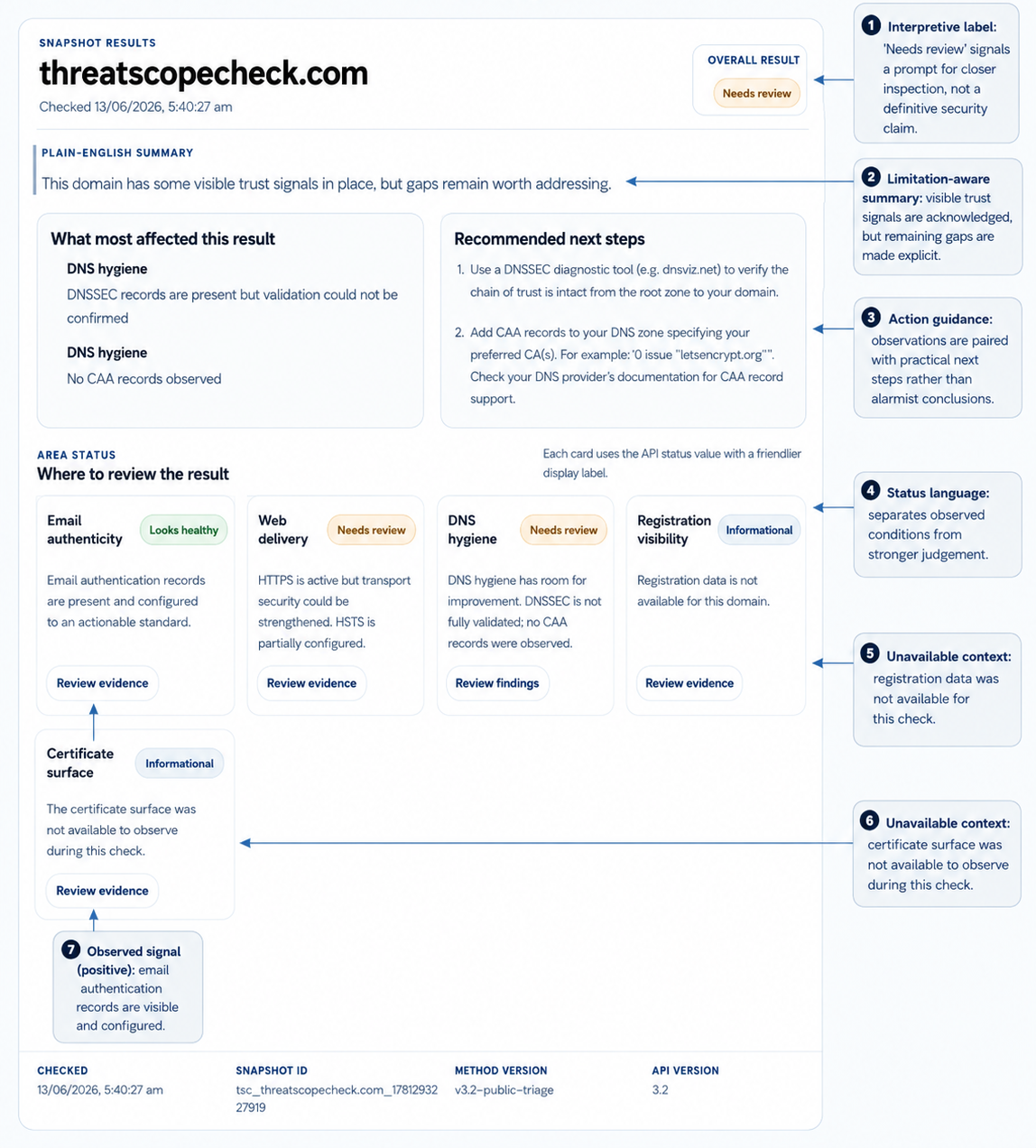
Annotated ThreatScope Check result view showing how observed signals, unavailable context and limitation language are separated in the report.
More certificate signal is not automatically more useful signal unless the report is clear about what was observed, what was unavailable, and what cannot be inferred.
Each additional signal creates another place where the result can become ambiguous. Certificate data may not always be available. RDAP varies between registries and providers. Some domains expose very little. Others expose many signals, but those signals still need to be read carefully.
That is where tooling can become misleading. A weak tool treats unavailable data as if it has no meaning. An overconfident tool treats partial data as if it has settled the question. A better tool should do neither.
It should show the signal where it exists, explain the absence where it does not, and avoid turning visibility into a claim it cannot support.
| Signal | What it can help show | What it cannot prove |
|---|---|---|
| DNS records | Which public records are visible for the domain at the time of lookup | That the organisation has mature internal governance |
| DMARC | Whether a domain publishes an email authentication policy | That all email use is authorised, aligned or well managed |
| DNSSEC | Whether DNSSEC-related protection is visible | That the broader domain environment is secure |
| RDAP | Publicly available registration or registrar context where available | That ownership, accountability or operational control is complete |
| Certificate visibility | Public certificate context associated with web-facing services | That every service is known, current or intentionally exposed |
| Nameservers | Where authoritative DNS appears to be delegated | That supplier ownership and change control are well governed |
| MX records | Which mail exchange providers are visible | That mail flows, sender controls or third-party senders are fully understood |
One of the strongest lessons from the 3.2 work is that missing data should not be hidden.
When RDAP fails, or certificate context is unavailable, the result can look thin if the interface simply shows a blank, an error, or an unexplained gap. The answer is not to pretend the signal exists. The answer is to explain the observation boundary.
A failed lookup is not automatically a governance failure. It may reflect RDAP variation, provider differences or unavailable certificate context. From the perspective of a reader, the important thing is knowing that the signal was attempted and could not be resolved.
That is a more honest result than silence.
This matters because public trust signals are often read by people who are not DNS specialists. A governance reader, communications lead, risk owner or executive may not know the difference between “not configured”, “not found”, “lookup failed” and “not applicable”. If the report collapses those into the same state, it creates confusion.
ThreatScope Check 3.2 pushed the report language to become more precise. The goal is not to make every result look complete. The goal is to make each result more intelligible.
The temptation with domain inspection tools is to score. A score is easy to understand. It gives a single answer. It turns a messy surface into something that feels decisive.
But that decisiveness can be false.
A domain can have strong visible signals and still have weak internal ownership. A domain can have missing visible controls because of a valid transitional state. A domain can sit behind a third-party provider where some signals are not obvious from the outside. A single lookup can show useful evidence, but it cannot carry the full burden of judgement.
That is why ThreatScope Check should not present itself as a definitive security rating. Its value is as an inspection surface: a way to bring public signals together, separate them from interpretation, and make the limits of observation explicit.
This is the same discipline I have been applying in .au Domain Observatory (.auDo), but from a different angle.
ThreatScope Check inspects a domain at a moment in time. .auDO observes patterns across a curated panel over time. One shows a point. The other shows behaviour.
Neither should pretend to be more complete than it is. Both become more useful when they are precise about method, scope and limitation. That is also why this work sits beside the broader Trust Surface Framework: the aim is not to make public signals dramatic, but to make them interpretable and governable.
ThreatScope Check
A focused view of public signals around a domain at the time of lookup, with report language that separates observation from inference.
.auDO
A curated observation practice that watches how selected Australian domain signals change over time without turning the panel into a score.
Something else became clearer during the 3.2 work: the report is itself part of the trust surface.
It is not enough for the underlying checks to be technically reasonable. The report has to communicate uncertainty responsibly.
That means the wording matters. “Missing” is different from “failed”. “Observed” is different from “verified”. “Visible” is different from “secure”. “Configured” is different from “governed”.
Small wording choices can either help a reader understand the signal or encourage them to overstate it. This has been one of the more important design challenges in ThreatScope Check. The work is partly technical, but it is also editorial. The interface needs to guide interpretation without creating false confidence.
A domain inspection report should not just return data. It should help the reader understand the status of that data.
ThreatScope Check 3.2 clarified the direction of the project. It is not trying to become a broad cyber scoring engine. It is not trying to make claims about an organisation’s internal security posture. It is not trying to replace specialist assessment, monitoring or governance work.
Its value is narrower and more useful: it helps make a public domain surface easier to inspect.
That surface includes the signals an organisation deliberately or incidentally exposes through domain configuration, mail authentication, certificate visibility, registration data and infrastructure choices. Those signals are not the whole trust story, but they are part of it.
Because they are public, observable and repeatable, they are worth taking seriously.
The work ahead is to keep improving inspection quality while preserving the discipline of non-claiming: better data, clearer results, more useful explanations and stronger handling of uncertainty.
A good trust inspection tool should surface what can be seen, explain what cannot be seen, and resist the urge to say more than the evidence allows.
That is the main lesson of ThreatScope Check 3.2. A single lookup shows a moment. Repeated observation shows behaviour. Responsible interpretation starts by knowing the difference.