
Field note
Email Authentication Is a Governance Signal
SPF, DKIM, DMARC, MTA-STS and TLS-RPT are often treated as deliverability settings, but they also reveal whether an organisation has clear ownership over who can speak using its domain.
Field note
SPF, DKIM, DMARC, MTA-STS and TLS-RPT are often treated as deliverability settings, but they also reveal whether an organisation has clear ownership over who can speak using its domain.
Most organisations only pay attention to email authentication when delivery breaks.
Something lands in spam. A campaign platform needs DNS records. A vendor says SPF, DKIM or DMARC needs to be fixed. Someone is asked to make the message arrive.
That framing is understandable, but it misses the larger issue.
Email authentication is not only about whether messages arrive. It is about whether an organisation can show that its domain is being used intentionally, controlled properly and protected from obvious forms of impersonation.
Weak email authentication shifts the burden of trust from the organisation to the recipient.
That is not a deliverability problem. It is a governance problem.
Email remains one of the most visible ways an organisation speaks.
It carries the ordinary machinery of trust: invoices, donation receipts, password resets, staff updates, support messages and incident notifications. For many people, email is still where an organisation's identity becomes practical.
Before someone reads the message, a trust decision has already started.
Is this really from the organisation it claims to be from? Was it sent by a system authorised to use that domain? Has the message been altered? What should happen if authentication fails? Can failures be seen and acted on?
Those questions sound technical. They are also questions of ownership, risk appetite and operational maturity.
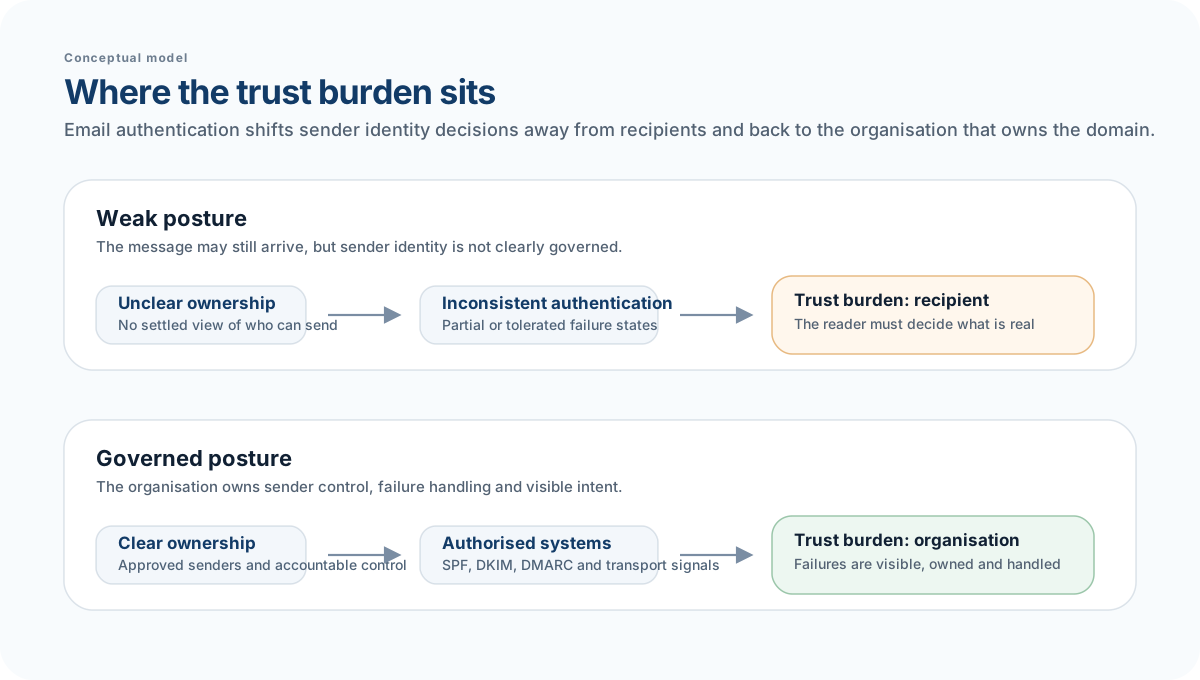
SPF, DKIM, DMARC, MTA-STS and TLS-RPT are usually discussed as mail settings. They are implemented through DNS records and mail infrastructure. They require technical configuration, testing and maintenance.
The records matter, but not because the acronyms are interesting.
Together, they show whether an organisation has a coherent view of who is allowed to speak using its domain.
| Control | Plain-English meaning |
|---|---|
| SPF | Which systems are allowed to send mail for this domain? |
| DKIM | Can the message prove it was authorised and not altered? |
| DMARC | What should receivers do when authentication fails? |
| MTA-STS | Should mail servers use secure transport when delivering to this domain? |
| TLS-RPT | Can the organisation see when secure mail transport is failing? |
The point is not that every governance reader needs to talk about these mechanisms in detail. The point is that the posture answers practical governance questions.
Who can send email using this domain? Who approves new sending platforms? What happens when unauthorised mail appears? Is enforcement being delayed because no one owns the risk? Can failures be observed, or are they invisible until someone complains?
A domain with weak or inconsistent email authentication may still deliver mail. Staff may still receive replies. Campaigns may still go out. Vendors may still send messages.
But “it works” is not the same as “it is governed”.
Consider a donor who receives a receipt from an organisation they recognise.
They are unlikely to inspect the message headers. They may not know whether the email passed SPF, DKIM or DMARC. They see a familiar name, a familiar domain and a message that appears to confirm a relationship of trust.
If the organisation has not governed who can send using that domain, the donor is being asked to make a trust decision without the right support.
That is the wrong place for the burden to sit.
The organisation controls the domain. It chooses the platforms it uses. It decides whether unauthorised use should be monitored, tolerated, quarantined or rejected. It owns the relationship between its name and the systems that speak on its behalf.
Email authentication is one of the few places where that ownership becomes externally visible.
Good posture does not mean perfection.
It does not mean every legacy system has been fixed overnight, every sender is already aligned or a strict DMARC policy appears immediately without preparation.
Good posture means there is clear ownership. It means the organisation knows which systems are authorised to send mail. It means new senders are approved deliberately, not added casually whenever a vendor needs a DNS change.
It also means there is a path from observation to action.
A monitoring-only posture may be sensible during discovery. A gradual move toward stronger enforcement may be necessary. Exceptions may exist. But those decisions should be visible, owned and time-bound.
The useful question is not only whether a domain has a DMARC record.
The better question is what the current posture says about ownership, intent, enforcement and operational maturity.
Email authentication does not prove that every email is safe.
It does not prove that a sender is ethical, that the message content is true, or that the organisation is secure. It does not replace fraud controls, user education, vendor governance, incident response or broader cyber security practice.
A well-authenticated email can still be misleading. A compromised authorised sender can still cause harm. A domain with good authentication can still have other weaknesses.
That distinction matters.
Email authentication is not a complete trust model. It is a visible control surface.
It shows whether an organisation has taken basic steps to govern sender identity, whether failed authentication is being tolerated or acted on, whether transport security has been considered, and whether there is evidence of operational ownership.
Public confidence is often shaped before a major incident occurs.
It is shaped by smaller signals: whether domains are well governed, whether sender identity is controlled, whether obvious impersonation pathways have been reduced, and whether the organisation can explain its own posture.
Email authentication sits directly in that space.
It is easy to dismiss as a mail setting. It is easy to leave to a vendor, a marketing platform or an inherited DNS record. It is easy to treat as a deliverability issue until something breaks.
But the deeper question is not whether the email got through.
The deeper question is whether the organisation has done the basic work to protect its own voice.
Email authentication protects more than delivery.
It protects trust.